
Two Ways of Looking at War
Sign up for blog updates!
Join my email list to receive updates and information.
In the aftermath of World War I, Kahlil Gibran wrote this in his best-selling classic, The Prophet: “There are those who have little and give it all. These are the believers in life and the bounty of life and their coffer is never empty.”
He continues beyond that passage to describe those who give with joy, those who give through pain, and finally those who give without any thought at all – the way a flower releases its fragrance unconsciously and completely.
As we pause on this Memorial Day 2026 to remember those who died in our wars, we should also mark something else Gibran said: through such givers, something divine speaks.
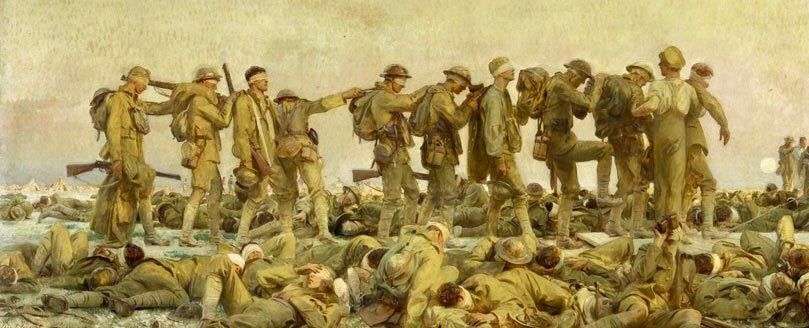
The spark of divinity glimmers through two poems of that era: Rupert Brooke's "The Soldier" and Ivor Gurney's "To His Love." And they enlighten us with two opposing views of war – romantic and horrific.
The first poem imagines war almost rhapsodically; the words of the second scrape like fingernails.
Rupert Brooke volunteered for active service at the outbreak of war in August 1914 and gained a commission in the Royal Naval Division. After his first combat engagement, he wrote five sonnets that at the time were lauded for their eloquent patriotism.
His poetry, redolent with patriotism and graceful lyricism, was revered in a country yet to feel the full devastation of two world wars, and he was a national hero even before his death in 1915 at the age of 27 – from a mosquito bite on his lip, which became infected.
Brooke's sonnet "The Soldier" was read from the pulpit of St. Paul's Cathedral on April 4, 1915 — just 19 days before his death on April 23.
The Soldier
by Rupert Brooke
If I should die, think only this of me:
That there’s some corner of a foreign field
That is for ever England. There shall be
In that rich earth a richer dust concealed;
A dust whom England bore, shaped, made aware,
Gave, once, her flowers to love, her ways to roam;
A body of England’s, breathing English air,
Washed by the rivers, blest by suns of home.
And think, this heart, all evil shed away,
A pulse in the eternal mind, no less
Gives somewhere back the thoughts by England given;
Her sights and sounds; dreams happy as her day;
And laughter, learnt of friends; and gentleness,
In hearts at peace, under an English heaven.
Ivor Gurney was both poet and composer. His output was prodigious: he left some two hundred songs, several chamber and instrumental works, and more than three hundred poems.
When war broke out, Gurney enlisted. At the front, he wrote the only two volumes of poetry published during his lifetime. He was shot at the Somme and gassed at Passchendaele and was discharged just before the Armistice in 1918.
Gurney returned home suffering from what we know today as Post-Traumatic Stress Disorder, to the point that he spent his last fifteen years institutionalized, where he wrote some of his best poetry.
To His Love
by Ivor Gurney
He's gone, and all our plans
Are useless indeed.
We'll walk no more on Cotswold
Where the sheep feed
Quietly and take no heed.
His body that was so quick
Is not as you
Knew it, on Severn river
Under the blue
Driving our small boat through.
You would not know him now ...
But still he died
Nobly, so cover him over
With violets of pride
Purple from Severn side.
Cover him, cover him soon!
And with thick-set
Masses of memoried flowers—
Hide that red wet
Thing I must somehow forget.
I will leave it to you to consider for yourselves which poet we should heed in our national ease at making war.
(Image: “Gassed” by John Singer Sargent is based on the scene at a dressing station taking in British casualties of a mustard gas attack in 1918.)