
Therapeutic Apheresis
January 9, 2026
Sign up for blog updates!
Join my email list to receive updates and information.
In which I write about the excrement of our era.
You know you’re getting old when a pretty girl sitting at the next table in a coffee shop leans over and offers to help you unwrap your cookie.
That’s what happened to me the other day at Ess-a-Bagel on West Thirty-second Street in Manhattan.
The young lady saw this “dude in distress” struggling to unwrap his Linzer torte from its plastic sarcophagus. She pulled out her apartment key and sliced the S.O.B. right down its middle.
Plastics have come a long way since 1907 when Belgian-American chemist Leo Baekeland developed Bakelite.
Today plastic in its multitudinous manifestations, is literally everywhere: string cheese, candy wrappers, potato chip bags. Around the world, some ninety percent of toys are made from plastic.
It’s not just me who’s complaining. The Consumer Product Safety Commission has tracked packaging-related injuries, and studies have shown that thousands of people visit emergency rooms each year for injuries related to opening various types of packaging, including the notorious clamshell plastic packaging, blister packs, and shrink-wrapped items.
These injuries typically include:
• Cuts and lacerations, the most common
• Puncture wounds
• Hand and finger injuries
• Eye injuries from flying plastic pieces or tools slipping
The problem has earned the nickname "wrap rage."
All of which prompted me to write this poem, after Mary Oliver’s “I Worried.”
Luddite’s LamentMy iWatch won’t tell me the time unless I first prove it’s me.Leave the car running while I step away with the fob in my pocketand it bleats like some kind of digital sheep about to be shorn.My passwords have morphed from a simple four numbersto strings of upper-case-lower-case-numerals-symbols. I’m captiveto autocorrect, robocalls and that eavesdropping siren, Siri.It’s impossible to kite a check to tide me over like I used to. Buttechnology has given me new prosperity of time, I’m assured,to squander away while I wander the net or simply expend myselfwith weekend work. And don’t get me started on plastic everything,the excrement of our era. Scissors are needed– to get at a KitKat bar!Oh give it up, I mutter, and haul your old man’s ass in for reconditioning.
What hurts is that I’m old enough to remember how nice things were before plastic. Milk, soda, and Windex came in glass bottles. As did peanut butter, jam, and honey – glass jars. Soap came in bars wrapped in paper.
When a young Dustin Hoffman was advised that his road to a great future in business lay in plastics, the line in The Graduate
was meant to elicit laughter.
We’re not laughing anymore.
Of all the plastics generated and used in the United States, roughly nine percent is recycled, twelve percent incinerated in facilities that create electricity or heat from garbage, and the remaining seventy-nine percent ends up in landfills and the environment.
There is a large area in the Pacific Ocean where currents have concentrated marine debris, particularly plastic waste. It's estimated to cover an area twice the size of Texas. And similar plastic garbage patches are in other oceans around the world.
What’s worst, I’d say, are the microplastics that enter our food through contaminated soil, water, animal feed, and packaging, and are often introduced during high-heat processing.
Foods with the most microplastics include breaded shrimp, plant-based nuggets, apples, carrots, and items from plastic-heavy packaging, with tea bags releasing billions of particles when steeped. Processed foods, seafood, and even fresh produce absorb them. Most chewing gum contains food-grade plastic polymers.
Microplastics are in our tissues and testosterone. Ouch.
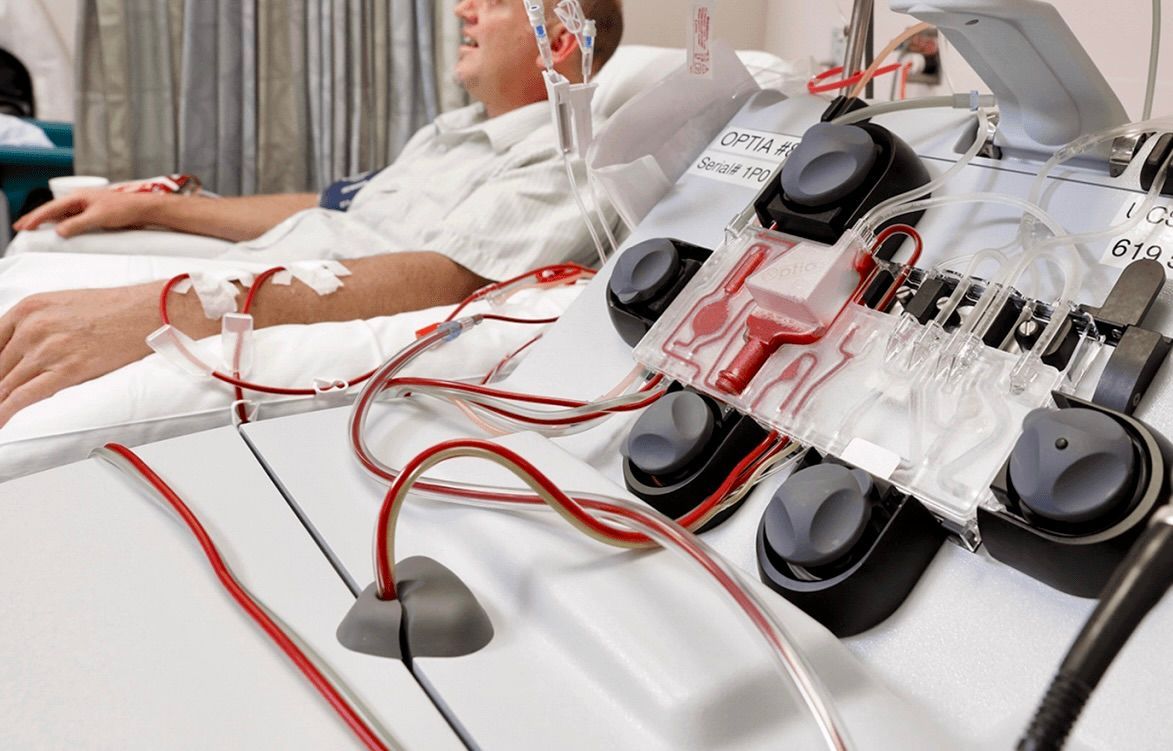
But don’t lose heart. There is a way to clean the stuff out of your system – a blood treatment technique related to dialysis, called therapeutic apheresis.
Apheresis removes the blood from your body, separates it into its components (plasma, red cells, white cells, platelets), removes the microplastics, and returns the cleansed blood to the patient.
Think your insurance plan covers that?