
Defiant Peace
Sign up for blog updates!
Join my email list to receive updates and information.
Finding peace despite the chaos
The Roman Stoic philosopher Epictetus, born a slave who tutored an emperor, understood better than most that we have very little power over external events. His central concept is a foundation for tranquility: the distinction between what is up to us and what is not.
"Some things are within our power, while others are not. Within our power are opinion, motivation, desire, aversion, and, in a word, whatever is of our own doing; not within our power are our body, our property, reputation, office, and, in a word, whatever is not of our own doing.”
It seems what causes us strife is when others impose on us what should be things “of our own doing.”
Most of our inner turmoil arises from trying to exert control over the "not within our power" stuff. When we fret over an economy hampered by stupidity, wars born of folly, or the opinions of the uninformed, we are fighting the tide.
Short of gunning down anybody and everybody who tries to tries to exert control over the things definitely within our purview, how do we navigate through the chaos?
St. Francis de Sales advised, "Never be in a hurry; do everything quietly and in a calm spirit. Do not lose your inner peace for anything whatsoever, even if your whole world seems upset.”
We want to believe that peace will be upon us when the chaos subsides. After the work is done. Once the relationship is mended. We wait for the storm to pass before we permit ourselves to breathe easy. And so we spend our years waiting in quiet desperation.
But the philosophers who have thought longest and hardest about this conclude the storm does not pass.
I refuse to submit to glib advice based on readings in Stoic philosophy, that we should retreat into the quiet of an interior fortress of the mind. This strikes me as a cop-out.
Peacemakers often, if not typically, act in defiance.
As Stoic as he was, Roman Emperor Marcus Aurelius did not retreat to his gardens to avoid his duties. He governed decisively.
Teresa of Ávila did not descend into her interior castle to escape the persecution of her own community. She returned with enough renewed energy to build seventeen convents.
Gandhi applied relentless truth-seeking through militant non-violence to topple an oppressor.
While Gandhi provided the method, Martin Luther King added the spirit – Christian Love. He dubbed nonviolence the "sword that heals," which cuts through the armor of subjugators without wounding them.
Gandhi and King refined their philosophies into political strategies. Christ’s pacifism was rooted in a revolution of the spirit. Neither fleeing nor striking back, he preached a third way – turning an enemy into a brother.
I’m concluding at this stage of my life that I am the only one who can captain my soul out of this global, warring morass we are in.
Rainer Maria Rilke spoke to me, I believe, in his Letters to a Young Poet written more than a hundred years ago:
You look to the surfaces, and this is what you should by all means avoid doing. No one can give you advice or help you. No one. There is only one thing to do: Go into yourself.
Pointless submission to chaos or purposeful declaration of peace? From Christ’s Sermon on the Mount to Gandhi’s Salt March, this is always the question before us.
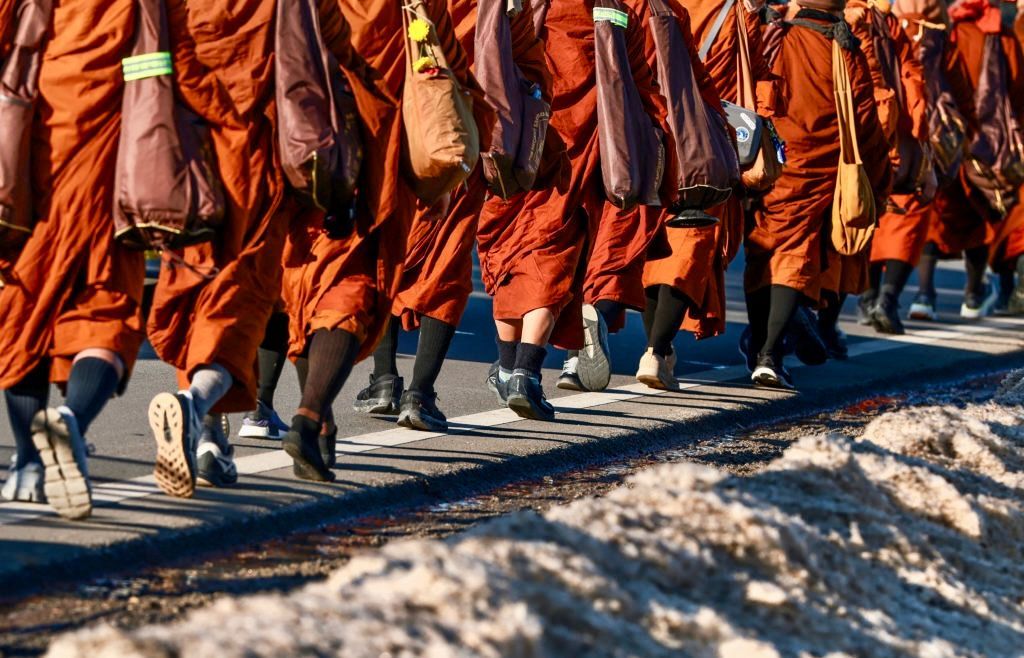
(Image: Theravada Buddhist monks who recently completed a defiant "Walk for Peace" across the U. S. and have since expanded their journey internationally.)